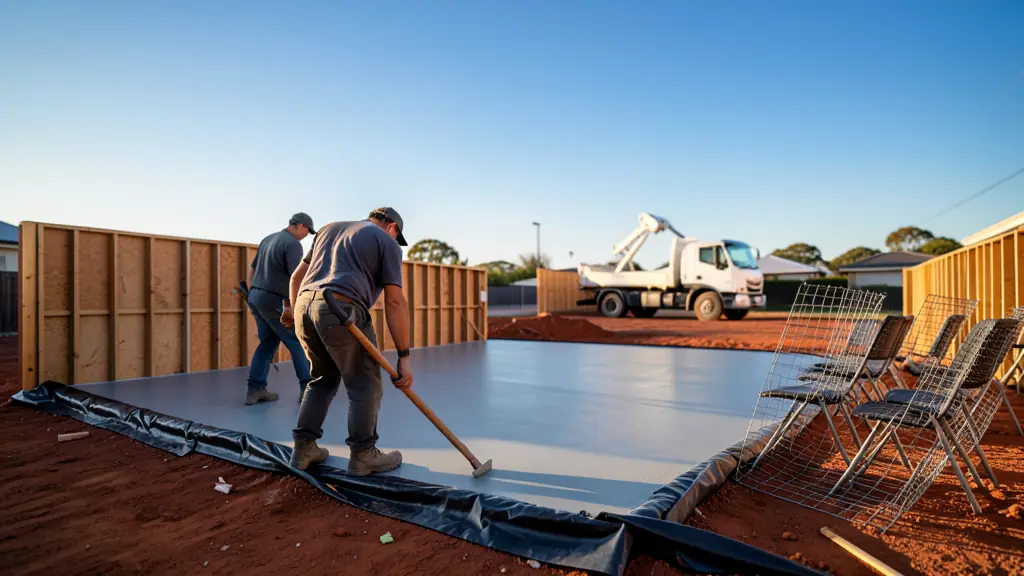
Everything above ground relies on concrete done right below it. Concrete contractors excavate and pour foundations, cast floor slabs and surface beds, lay driveways and build footings for walls, carports and tanks. BuildingContractors.co.za doesn't do concrete work itself. Tell us what you need, the size and where you are, and we pass your request to independent concrete contractors serving your area. They visit or review your plans and quote you directly. The request is free and there is no obligation to accept a quote.
Foundations and footings
Most houses stand on strip footings under each load-bearing wall, sized to the soil and the load. Building foundation contractors set out the trenches from the approved plans, excavate to firm ground and cast the footings, often with Y12 rebar where the engineer specifies it. On the Highveld and in parts of the Free State, expansive clay swells and shrinks with the seasons, so a structural engineer may call for deeper footings, reinforced rafts or a soil report. For new homes enrolled with the NHBRC, foundations are inspected before the slab goes in, and an engineer signs off where required under SANS 10400.
Concrete slabs and surface beds
A ground-floor concrete slab, or surface bed, is usually poured on compacted fill, a damp-proof membrane and reinforcing mesh such as ref 193. Good compaction in layers matters more than people think: poor fill is a common cause of cracked and sinking floors. Suspended slabs for double-storey homes are a separate job, needing engineered designs, props, shuttering and steel. Ask how the contractor will compact, cure and joint the slab.
Driveways, paths and yards
Concrete driveways need a well-compacted base, reinforcement where specified, a thickness that suits the vehicles using them, and control joints cut or formed so that cracks happen in straight lines. Finishes include broom, exposed aggregate and stamped patterns. For heavy trucks or industrial yards, ask for a design from an engineer.
Ready-mix or site-mixed concrete
Larger pours usually use ready-mix delivered by truck, sometimes with a concrete pump where trucks can't reach. Small jobs are often mixed on site with 50 kg bags of cement, sand and 19 mm crusher stone. Either way, the right strength, enough cement, no extra water on site and proper curing for several days decide how the concrete performs. A good quote states the concrete strength, thicknesses, steel, who supplies the materials and how the work will be paid in stages.
Comparing quotes for concrete contractors
The lowest price is not always the best value. When your quotes arrive, check:
- Scope: what is included item by item, and which materials the contractor supplies.
- Payment: a deposit and payments in stages as work is completed, never most of it upfront.
- Time: the start date, how long the work will take and what happens if it runs late.
- Compliance and guarantee: approvals and certificates needed for the job, and the guarantee on workmanship.
What to include in your request
- What you need: foundations, slab, driveway or footings
- Size in m² or metres, and thickness if your plans show it
- Approved plans and engineer's drawings, if you have them
- Soil type or slope, and whether a concrete truck can reach the site
- Whether the contractor supplies concrete and steel, or labour only
Frequently asked questions
Are you a concrete company?
Do I need an engineer for foundations?
How thick should a concrete slab be?
Why does new concrete crack?
Concrete Contractors by province
- Concrete Contractors Gauteng
- Concrete Contractors Western Cape
- Concrete Contractors KwaZulu-Natal
- Concrete Contractors Eastern Cape
- Concrete Contractors Free State
- Concrete Contractors Limpopo
- Concrete Contractors Mpumalanga
- Concrete Contractors North West
- Concrete Contractors Northern Cape
Concrete Contractors by city and town
- Concrete Contractors in Johannesburg
- Concrete Contractors in Pretoria
- Concrete Contractors in Centurion
- Concrete Contractors in Sandton
- Concrete Contractors in Midrand
- Concrete Contractors in Randburg
- Concrete Contractors in Roodepoort
- Concrete Contractors in Alberton
- Concrete Contractors in Boksburg
- Concrete Contractors in Kempton Park
- Concrete Contractors in Benoni
- Concrete Contractors in Germiston
- Concrete Contractors in Krugersdorp
- Concrete Contractors in Vereeniging
- Concrete Contractors in Vanderbijlpark
- Concrete Contractors in Soweto
- Concrete Contractors in Edenvale
- Concrete Contractors in Umhlanga
- Concrete Contractors in Cape Town
- Concrete Contractors in Bellville
- Concrete Contractors in Somerset West
- Concrete Contractors in Paarl
- Concrete Contractors in Stellenbosch
- Concrete Contractors in George
- Concrete Contractors in Mossel Bay
- Concrete Contractors in Worcester
- Concrete Contractors in Durban
- Concrete Contractors in Pinetown
- Concrete Contractors in Pietermaritzburg
- Concrete Contractors in Richards Bay
- Concrete Contractors in Ballito
- Concrete Contractors in Margate
- Concrete Contractors in Newcastle
- Concrete Contractors in Port Elizabeth (Gqeberha)
- Concrete Contractors in East London
- Concrete Contractors in Bloemfontein
- Concrete Contractors in Welkom
- Concrete Contractors in Polokwane
- Concrete Contractors in Tzaneen
- Concrete Contractors in Nelspruit (Mbombela)
- Concrete Contractors in Witbank (eMalahleni)
- Concrete Contractors in Middelburg
- Concrete Contractors in Secunda
- Concrete Contractors in Rustenburg
- Concrete Contractors in Klerksdorp
- Concrete Contractors in Potchefstroom
- Concrete Contractors in Kimberley
- Concrete Contractors in Hermanus
- Concrete Contractors in Knysna
- Concrete Contractors in Plettenberg Bay
- Concrete Contractors in Jeffreys Bay
Related services and supplies
- BC-01Building ContractorsNew houses, extensions, alterations, outbuildings and repairs
- BS-05Ready-Mix ConcreteConcrete batched to strength in MPa, e.g. 15, 20, 25 or 30 MPa
- BS-10Steel SuppliesHigh-tensile rebar such as Y10, Y12 and Y16 to SANS 920
- TR-02Paving ContractorsDriveways, patios, pool surrounds, walkways and parking areas