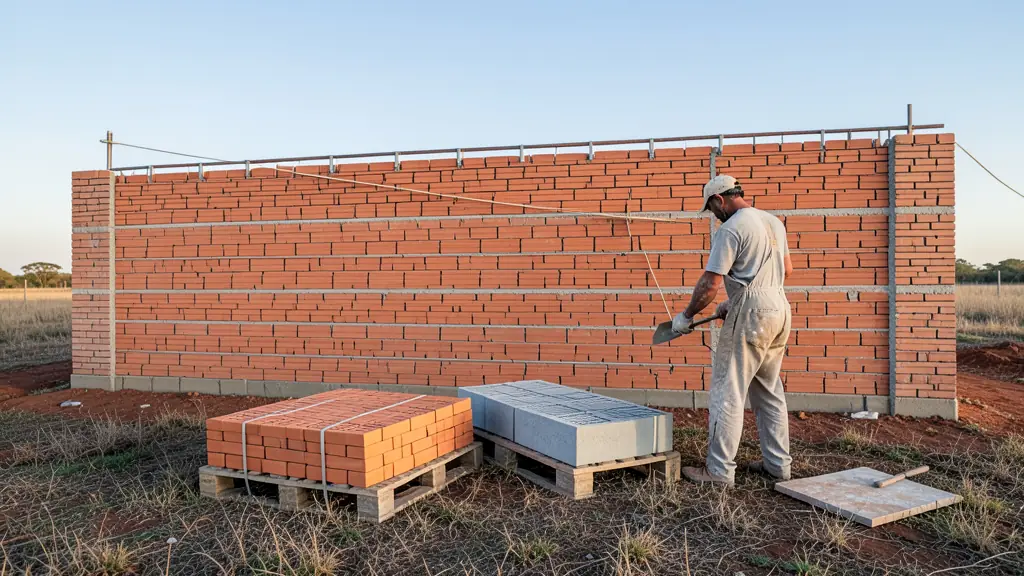
Most South African houses are still built from bricks, and choosing the right type affects the look, strength and cost of every wall. BuildingContractors.co.za helps you compare. Tell us which bricks you need, how many and where you are building, and we pass your request to independent brick yards and building merchants serving your area. They quote you directly, so you can compare bricks price, availability and delivery. We don't make, sell or deliver bricks ourselves. The request is free and there is no obligation to accept.
Types of bricks used in South Africa
- Clay stock bricks: fired clay bricks for walls that will be plastered, the standard choice for many houses
- Face bricks: clay bricks with a finished face and consistent colour, laid without plaster on exposed walls
- Maxi bricks: larger bricks, usually cement, that build a wall faster with fewer bricks per m²
- Cement bricks: concrete bricks for plastered walls, foundations and boundary walls
- Cement blocks: hollow or solid blocks for boundary walls, outbuildings and quick construction
Stock bricks and cement bricks come in standard and maxi sizes. Check the dimensions, as they change how many you need.
How many bricks do you need?
As a rough guide, a single-skin wall uses about 50 to 55 standard bricks per m², and roughly 35 maxi bricks per m². A double-skin (220 mm) wall uses about twice as many. Work out the wall area, subtract doors and windows, multiply by the bricks per m² and add around 5% for breakages and cuts. Your builder or the supplier can check the quantity from your plans. Remember mortar too: building sand and cement are ordered alongside the bricks.
Bricks prices: a rough 2026 guide
Bricks are priced per brick or per 1,000. As a very rough 2026 guide, common cement and clay stock bricks often fall somewhere around R2.50 to R5 a brick, while face bricks can cost from about R5 to well over R10 depending on the range. Prices vary widely by region, distance from the factory, quantity and delivery. Treat these figures as a starting point only and get current quotes for your exact brick and quantity.
Strength, standards and climate
Bricks used in structural walls should meet the relevant SANS standard and the strength your plans call for, as required under SANS 10400. Foundations and retaining walls may need stronger units. On the Highveld, expansive clay soils make good foundations and brickforce in every few courses important to limit cracking. At the coast and in the Cape winter rain, face bricks and good mortar joints resist damp better than poorly burnt or soft bricks. Ask your supplier for the product's strength class and use.
Comparing bricks prices
Material prices change with demand, transport costs and quantity. When quotes arrive, check:
- Exact product: type, size, grade or strength, and the SANS mark where one applies.
- Quantity: per unit, per pallet, per m³ or per load, and whether there is a minimum order.
- Delivery: the delivery charge, offloading, and access for a large truck or crane truck.
- VAT and validity: whether the price includes VAT and how long it is held.
What to include in your request
- Brick type, size and colour or range, if face brick
- Number of bricks, or wall lengths and heights
- What the bricks are for: foundations, house walls or boundary wall
- Delivery address and where the truck can offload
- Whether you also need cement, sand and brickforce
Frequently asked questions
What is the difference between stock bricks and face bricks?
Are maxi bricks cheaper than standard bricks?
Can I use cement bricks instead of clay bricks?
Do brick suppliers deliver?
Bricks by province
- Bricks Gauteng
- Bricks Western Cape
- Bricks KwaZulu-Natal
- Bricks Eastern Cape
- Bricks Free State
- Bricks Limpopo
- Bricks Mpumalanga
- Bricks North West
- Bricks Northern Cape
Bricks by city and town
- Bricks in Johannesburg
- Bricks in Pretoria
- Bricks in Centurion
- Bricks in Sandton
- Bricks in Midrand
- Bricks in Randburg
- Bricks in Roodepoort
- Bricks in Alberton
- Bricks in Boksburg
- Bricks in Kempton Park
- Bricks in Benoni
- Bricks in Germiston
- Bricks in Krugersdorp
- Bricks in Vereeniging
- Bricks in Vanderbijlpark
- Bricks in Soweto
- Bricks in Edenvale
- Bricks in Umhlanga
- Bricks in Cape Town
- Bricks in Bellville
- Bricks in Somerset West
- Bricks in Paarl
- Bricks in Stellenbosch
- Bricks in George
- Bricks in Mossel Bay
- Bricks in Worcester
- Bricks in Durban
- Bricks in Pinetown
- Bricks in Pietermaritzburg
- Bricks in Richards Bay
- Bricks in Ballito
- Bricks in Margate
- Bricks in Newcastle
- Bricks in Port Elizabeth (Gqeberha)
- Bricks in East London
- Bricks in Bloemfontein
- Bricks in Welkom
- Bricks in Polokwane
- Bricks in Tzaneen
- Bricks in Nelspruit (Mbombela)
- Bricks in Witbank (eMalahleni)
- Bricks in Middelburg
- Bricks in Secunda
- Bricks in Rustenburg
- Bricks in Klerksdorp
- Bricks in Potchefstroom
- Bricks in Kimberley
- Bricks in Hermanus
- Bricks in Knysna
- Bricks in Plettenberg Bay
- Bricks in Jeffreys Bay